In the face of heart-wrenching challenges that left many of us feeling very troubled (read: angry, confused, and afraid) we remained committed to the deeply magical acts of connecting and co-creating. From transforming difficult emotions into empowered action, to the pure pleasure of crystal dildos, we give you the Best of The Numinous 2016. Cause we gotta have faith, cosmic crusaders…
6. Cosmic Calling—Astrology for Entrepreneurs:When it comes to astrology for entrepreneurs, it’s about knowing your cosmic career signature, and following a few hard and fast rules, says Rebecca Gordon.
7. Empowered Action in the Face of Trauma:Recent world events have stirred up many intense emotions. Louise Androlia shares her wisdom on how to use our feelings as a catalyst for empowered action.
8. Fashion as Self-Love: The Story Behind KE7H3R: “Everything, even fashion, is a transference of energy.” Janelle Corpuz Hethcot talks sartorial style as self-love with Ruby Warrington.
9. Hello Chakrubs: Yes, That’s a Crystal Dildo: Forget the battery-operated vibrator and pick up a high-vibe, soul-opening crystal sex toy. Chakrubs founder Vanessa Cuccia shares her story with Gabriela Herstik.
10. Casting My Spell—Confessions of a White Witch:“I see writing as a spell, decorating my home as a spell, singing as a spell. Whenever I express myself I am casting MY spell.” Shaheen Miro shares what it means to grow up and embrace being a white witch.
Want more Numinosity in 2017? Sign up for our newsletter and follow us on Instagram and Facebook so you never miss a post.
Ahead of her appearance at the MOTHERSHIP festival in Joshua Tree, Alexandra Roxo chats to founder Laura Wise about feminism, kundalini, and kink…
High vibe festivals are everywhere. From Wanderlust to Symbiosis to Spirit Weavers—there’s a festival for ever breed of seeker. Or is there? MOTHERSHIP—happening November 4-6th in Desert Hot Springs, CA—is unique in that it’s feminist AND queer AND spiritual. You can do yoga , celebrate sacred adornments, and then go to a Kink workshop. Amazing, right?
I sat down with the founder (who is also an activist and therapist) Laura Wise to get the deets.
ALEXANDRA ROXO: What can we really expect at a festival like MOTHERSHIP? LAURA WISE: Women are so typically the caretakers. It is engrained in us to be sweet/kind/giving and that is why self-care is so important. Mothership is full of healing elements and ways to explore your spiritual side. Sierra Dowd is running a “Circle of Release” exercise in which participants can work to release negative aspects of their lives. We have reiki healers, chakra aligning yoga, punk rock yoga, meditation, nature hikes, stargazing (there will actually be a meteor shower during this time!) and lot’s more…
AR: How did the idea for Mothership emerge? LW: MOTHERSHIP is the event I’ve always wanted to attend. After visiting some pretty magical festivals and gatherings and learning that the pool of women’s festivals is teeny-tiny and nearly extinct, I knew that this was a need I wanted to meet. Women thrive when we unite and work together. We learn from each other and we empower one another. I knew that if I created something fun—with a side of empowerment—there would be an audience for that. This is the era of a fresher, more inclusionary feminism, and I really want to have a hand in building that.
AR: How is it different from other female-focussed festivals or retreats? LW: One thing I knew was crucial in the creation of MOTHERSHIP was that it was trans and gender-queer inclusive. If you take a look back at the history of women’s festivals—the most established being the Michigan Womyn’s Festival which ended several years ago—there was a clash in new and old thinking. They didn’t allow trans women to attend and the younger generation wasn’t okay with that. We wanted to correct that and update the idea of a women’s festival.
AR: What kinda gal is your typical attendee? LW: She doesn’t exist! The MOTHERSHIP crowd is diverse and forward-thinking. But our participants all have an appreciation for idea exchange, art and letting loose. We have a lot of interesting, smart women involved and the thing I’m most excited about is seeing all of these great minds culminate & celebrate!
AR: What are your wildest hopes for the weekend? LW: My personal goal is that everyone leaves with a little less shame and self-doubt, and a little more personal pride. I hope that MOTHERSHIP can serve as a reminder to us all to celebrate & empower the women around us. I hope that the gal who thought the event sounded fun, and didn’t know much about feminism, leaves saying “yeah I’m a feminist and I have every right to be proud of that.”
AR: Any must-see workshops? LW: Gosh I really want to brag about everyone involved, I am stunned at the level of awesome-ness! We have a lot of unique workshops happening, including a self-adornment area with tons of free costumes, accessories and body paint/glitter etc. paired with a Self-Love Photographer, to help you get just the right photo to document your experience. There’s also an intro to kink and BDSM sex workshop, which I know a lot of people are curious about. Late-night we will be having a silent disco…and then there’s the musical lineup—which is also pretty epic!
PLUS our very own Numi Alexandra Roxo will be speaking on Saturday night at the HER Talk: Women’s Sexuality in the Media panel. Get your tickets at this link—Numinous readers get 10% off with the code “MOON”!
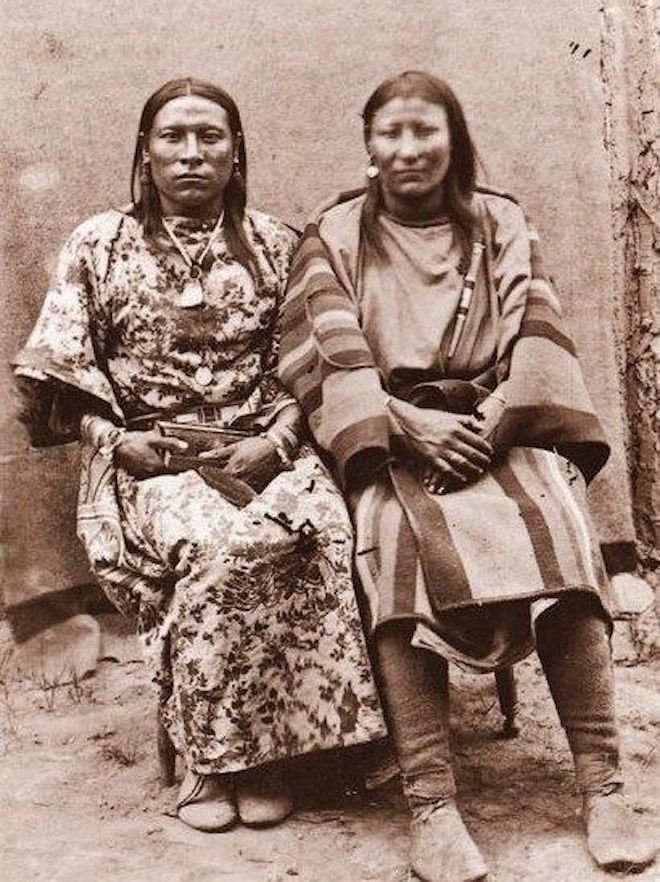
Prior to Christian intervention, fluid gender identities of the Native American Two Spirits were seen as a gift from the gods, says Pearson McKinney…
Celebrated Lakota Two Spirit Osh-Tisch (left) with his wife.
It wasn’t until Europeans took over North America that natives adopted the ideas of gender roles. For Native Americans, there was no set of rules that men and women had to abide by in order to be considered a “normal” member of their tribe.
In fact, people who had both female and male characteristics were viewed as gifted by nature, and therefore, able to see both sides of everything. According to Duane Brayboy, writing in Indian Country Today, all native communities acknowledged the following gender roles: “Female, Male, Two Spirit Female, Two Spirit Male and Transgendered.”
He goes on to describe how: “Each tribe has their own specific term, but there was a need for a universal term that the general population could understand. The Navajo refer to two spirits as nádleehí (one who is transformed); among the Lakota is winkté (indicative of a male who has a compulsion to behave as a female), niizh manidoowag (two spirit); in Ojibwe, hemaneh (half man, half woman), to name a few.”
As the purpose of ‘Two Spirit’ is to be used as a universal term in the English language, it is not always translatable with the same meaning in native languages. For example, in the Iroquois Cherokee language, there is no way to translate the term, but the Cherokee do have gender variance terms for ‘women who feel like men’ and vice versa.”
The Two Spirit culture of Native Americans was one of the first things Europeans worked to destroy and cover up. According to people like American artist George Catlin, the Two Spirit tradition had to be eradicated before it could go into history books. Catlin said the tradition: “must be extinguished before it can be more fully recorded.”
And as Brayboy also notes: “Spanish Catholic monks destroyed most of the Aztec codices to eradicate traditional Native beliefs and history, including those that told of the Two Spirit tradition.” As a result, Native Americans were forced to dress and act according to newly designated gender roles.
One of the most celebrated Two Spirits in recorded history was a Lakota warrior fiercely named Finds Them And Kills Them. Osh-Tisch (see main image) was born a male and married a female, but adorned himself in women’s clothing and lived daily life as a female. On June 17 1876, Finds Them And Kills Them earned his stripes when he rescued a fellow tribesman during the Battle of Rosebud Creek, an act of fearless bravery.
It’s an example of how in Native American cultures, people were valued for their contributions to the tribe, regardless of the gender attributes they exhibited. Parents did not assign gender roles to children either, and children’s clothing tended to be gender neutral. There were no ideas or ideals about how a person should love; it was simply a natural act that occurred without judgment.
Without a negative stigma attached to being a Two Spirit, there were also no inner-tribal incidents of retaliation or violence toward the chosen people simply due to the fact they identified as the opposite or both genders. If anything; “Traditional Native Americans closely associate Two Spirited people with having a high functioning intellect (possibly from a life of self-questioning), keen artistic skills and an exceptional capacity for compassion,” writes Brayboy.
We’wha (1849-1896), of the Zuni nation. We’wha was biologically male and engendered with a female spirit.
Once outside religious influences brought serious prejudice against “gender diversity,” openly alternative or androgynous people were forced into to one of two choices. They could either live in hiding, and in fear of being found out, or they could end their lives. Many of whom did just that.
Imagine a world where people allowed others to live freely as the people nature intended them to be, without harm, without persecution, without shame. Imagine a world where we are truly free.
In the summer of 2015, the Numinous and I teamed up to create an interactive art installation and event space called the Temple of Venus. As an altar to the goddess Venus the installation served as a healing space: the events at the Temple were a way to address our questions and questings regarding love, sexuality, beauty, money and everything else Venus touches. So why did we choose Venus? Who is she? How might the goddess inspire and impact your life? How are you already an embodiment of Venus? All questions I want to answer with this column!
Six months after creating the temple, Venus has not stopped working with and guiding me. And so this is a space for me to share some Venetian wisdom each month, to help get our juicy, abundant, sexual, prosperous selves truly flowing.
Venus is the Roman goddess of love, beauty, sexuality, abundance, desire, fertility, and finances. She is known as Aphrodite in Greek mythology. Astrologically, the planet Venus (don’t you love when your goddess is also a planet?) rules relationships. So, for example, if you’re born with Venus in Scorpio, your way of being with and relating to people is imbued with the energy of a fiercely loyal and passionate Scorpio.
Goddess Venus teaches us to be accepting of all facets of our womanhood and sexuality. In fact, one of the qualities that separate Venus from the Aphrodite myth, is that Venus was also the goddess of prostitutes. She allows for sexuality to be fluid, to exist in a space without judgment. In her brilliant book, Ecstasy is Necessary: A Practical Guide, celebrated tantra teacher Barbara Carrellas offers the reader a “sexual permission slip” or a series of permissive statements about how one can choose to regard sex.
A particularly strong one is: “I give myself permission to talk about sex as a safe, sane, and consensual act that brings health and pleasure to the world.” Venus celebrates this perspective. I find Venus to be a powerful goddess for sexual healing because she shows us that sex is beautiful. She shows us that sex is a gift of pleasure from the Divine, and she helps us tap into that pleasure.
When preparing for a ceremony in the temple with Lyndsey Harrington and Kat Hunt of Moon Church, we decided to invoke the goddess Venus and tune into her energy in order to decide how to best serve her with our ritual. We were flooded with her essence: it felt orgasmic and ecstatic, yummy and beautiful. She told us that she loved milk, honey, pearls, gold, kisses, and roses. And Kat said that she felt it showed that as well as the goddess Venus, the other Greek and Roman gods and goddesses are waiting for us connect with them.
This message was eye-opening to me. I realized that in much of my goddess worship and ceremony, I had never thought of the Greek and Roman goddesses as vital, present, divine forces waiting to help us. I’d worked with the Divine Mother Mary and Kwan Yin before but never with a Greco-Roman goddess directly. What I’ve since learned is that Venus is so ready to bestow her love and magic and beauty upon those who are willing to invoke her with an open heart. And that she can help you tap into your sexual and goddess essence and your sense of worthiness in such deep ways.
In fact, Venus is a symbol of the divine feminine (and remember we use the Venus symbol “♀” to mean “female”). Venus was born of the water, and water is a sublimely gorgeous metaphor for the female principal. Water receives, it takes in. It is abundance, it is creation, it is sensitive, it is psychic, it is adaptable. As women, as birthers, we are able to tap into the deep waters of creation and imagination.
Water is our element, and the goddess Venus reminds us to claim all of its gifts. In working with her directly, we learn how to be better receivers, better lovers, and better mothers to ourselves and others. And the planet Venus has a twin flame: it is the planet Earth. May this column honor the waters of Earth and the fires of our twin planet to create cosmic balance and upliftment for all.
Up next month: A Venus-inspired meditation for calling in your soulmate.
“It’s like a guidebook for men to be more happy and free, but in a way that’s still masculine. And part of it is by owning their role as a male.”
When did you decide to make men and spirituality a focus? I’ve been totally steeped in the Eastern spirituality thing for decades, but the men’s work was always in the background. Then I got into my 40’s, went through a divorce, got into another relationship, and all of a sudden I’m having a son. And it all just came home.
How does spiritual work look different for dudes? It’s about practicality. For most men there really needs to be some kind of pay off, where the rubber meets the road. Most men wouldn’t be caught dead in a meditation class or a retreat, unless they knew it was going to help them with their work, their relationships with their loved-ones. They just won’t even do it.
Don’t men sometimes just feel out of place? There’s so much talk about ‘divine feminine’ this, and ‘Goddess energy’ that. I kind of feel like men must be thinking, ‘okay, so are my urges and drives redundant now?’ I don’t think it’s so much that men have that whole thought, like, ‘where do I fit into this?’ I think they just think ‘this is not for me. I’m going to sit home and drink beer and watch the game while my wife goes to the yoga retreat. Because that’s just not something that would be of interest to me at all.’
So part of it is about honoring the masculine energies as sacred too. On the Eastern spirituality scene the energy is predominantly feminine. And even anti-masculine, in the sense that it’s all mostly about peace, compassion, and softness. The average person, when they hear that I’m doing a spiritual book for men, they’re like, ‘Oh, good. You’re going to teach them to open their hearts.’ It’s like, ‘Yeah, I’m going to teach them to open their hearts, but the book is really about growing a backbone and balls.’
Ha! So should women be encouraging men to go on the yoga retreat with them? I don’t think most men will necessarily get what they need from bending over in a room full of women. Of the 8% of men that will go, there’s an even a smaller percent of heterosexual men. It’s kind of like we have to go into our feminine to be able to be in that. Or at least fake it. And that’s when you get the yoga teacher who ends up in some sex scandal – because they feel like they can’t just say, ‘Hey, I think you’re really sexy, and you’re my student, but why don’t we go get a drink?’ Instead they feel they have to be like, ‘Yeah, I think you should come for a private session because I need to open your hips’ or something. You know? The heterosexual desire is made illegitimate.
So what are some spiritual exercises that you do with guys? In my book there’s a big chapter on the ‘father wound,’ and it’s a real central thing for most men. He was my teacher on what it means to be a man, so did I learn from him? I also like to connect men to a sense of vision, because men without a vision are really lost. They need to have a mission. They need to know what they’re moving toward and be able to say, ‘Yes, I’m still moving toward it, I’m getting closer, or I’m going the wrong direction.’ So I try to help men find that. The other thing is to just get them used to being in a conversation with each other.
Without any beer. Because that’s often what it takes, right? Exactly. And in my experience, men tend to communicate a lot better shoulder-to-shoulder than face-to-face. I had one veteran that I worked with a lot, and often times I would go sit at the bar with him, with the bartender there washing the glasses or whatever, and we’d do a session. My office, with the chairs facing each other, felt awkward – maybe too intimate.
Who are your typical clients for this kind of work? What I get a lot is the partners of my female students, and partners of women who are already involved with spirituality. They either see my stuff as a safe way for their man to get involved in it, or sometimes they want me to fix their man. At my Kripalu weekend last year, half the men were there because their wives had given them a father’s day gift, in hopes that somehow they would get fixed.
And…what happens if the wife is part of what needs fixing? This is actually quite typical. A man comes because his wife tells him he’s too angry, and society has told him that he has an anger issue. So he comes, thinking I’m going to teach him to breathe and not be angry. But instead I break down anger from the point of view of the Bhagavad Gita, which says anger is there when a desire is thwarted. So then I say, ‘Okay, man, you’re angry, and that’s beautiful. What are you wanting that you’re not getting? Like at a deep level.’ And I unleash them to go after what they want in their life. And sometimes that means they go home and they divorce their wives.
I know you have a theory about the difference between a boy, a guy, and a man. What’s that about? The distinction I’m trying to make is that a man is someone who’s done some work on himself, and I think there’s definitely a sense of honor and sacrifice and strength. A man is ready to protect his world and serve his world, whereas a guy is just mostly about himself. A ‘dude’ is usually like a hipster, even more self-absorbed. Males in our society get into this really immature self-absorption thing.
How does that ‘man’ifest (ha)? It looks like; ‘he’s not living his truths.’ He’s either living what his father wanted him to do, or he’s trying to live the opposite of that. He doesn’t really want to sit in this job and work in this job; he wants to be an entrepreneur, but he’s too scared. Or he doesn’t want to be in this marriage because he doesn’t get anything out of it, but he just doesn’t feel like he’s empowered to leave.
And so he makes excuses; ‘But I’ve got to bring home the bacon.’ Or, ‘it doesn’t matter. I’ll just watch some porn, beat off, just try to entertain myself a little bit.’ What I’m interested in is training men to be on fire with passion and vision, so they are bringing those values to their family and bringing that masculine energy to the house so that their woman can be in her feminine energy and not feel like she has to be the brains of the operation all the time.
You can be totally gluten free and only think nice thoughts, but if you’re a terrible lover or you don’t know how to make money, or you don’t know how to take care of your kids, all of that is for naught in my point of view.
What do you wish you could tell the average man in the street about spirituality, and how to tap into his spiritual power in a masculine way? That they don’t have to do it alone. A lot of men just don’t have other quality men in their life in a quality way, and so they put all their emotional care in the hands of their women. And oftentimes they’re really isolated from other men. One of the first questions I ask any man who’s suffering, is; ‘Do you have good men in your life?’ And the answer is almost always no. Men need a network of other men that they can really talk to about their fears, but also about their strengths.
How are the men in your life getting in touch with their spirituality? Connect with us and share your stories on Twitter, Instagram and Facebook.